Vol.37/No.4 (146) (2022)

Vol.37/No.4 (146) (2022)

Special Issue: Application of Artificial Intelligence in Structural Engineering
Guest Editor: Tzu-Kang Lin

TitleFramework of Advanced Building Inspection withRoute Planning, Defect Detection, and Damage Rating
AuthorShun-Hsiang Hsu, Ho-Tin Hung, Yun-Man Hsu, Chia-Ming Chang, Tzung-Wu Chen, Chun-Chung Chen
Keywordsvisual inspection; damage detection; damage quantification; deep learning
AbstractVisual inspection is commonly adopted for building operation, maintenance, and safety. The durability and defects of components or materials in buildings can be quickly assessed through visual inspection. However, implementations of visual inspection are substantially time-consuming, labor-intensive, and error-prone because useful auxiliary tools that can instantly highlight defects or damage locations from images are not available. Therefore, an advanced building inspection framework is developed and implemented with route planning, realtime and detailed damage recognition, and damage rating in this study. The inspection route sketching is first exploited to provide an efficient plan with significantly reduced disruption. Then, Scaled-YOLOv4 and SOLOv2 models are considered in this study to detect defects even in a large-scale field quickly and acquire pixel-level damage recognition for more precise quantification, respectively. Finally, damage levels of components are rated following the importance and numbers per unit area of the detected defects. This entire framework is also implemented and verified by the hallway of an elementary school to detect and quantify surface damage of concrete components. As seen in the results, the conventional building inspection is significantly improved by the aid of the proposed framework in terms of damage localization, damage quantification, and inspection efficiency.
TitleLinear Static Analysis with Graph Neural Networks
AuthorYuan-Tung Chou, Kuang-Yao Li, Po-Chih Kuo, Wei-Tze Chang, Yin-Nan Huang , Chuin-Shan Chen
Keywords 
AbstractStructural design is an iterative process for optimum selection, which relies on structural analysis results and experience from structural engineers. Since iterative structural analysis is a necessary for getting a good design, accelerating structural analysis is an important task. In this work, we adopt deep learning approaches as a surrogate model for linear static analysis, which provides fast and accurate structural response prediction. Based on the similarity between the structure’s topology and graph data structure, we represent structures as graphs and leverage graph neural networks (GNNs) to learn the relationship between given external forces and corresponding structural responses. The GNN model is trained with random-generated structures, including random story number, span number, beam-column length, and value of external forces. The results show that the GNN model has good performance on displacement and force predictions and excellent generalizability on unseen, taller structures. In addition, it is shown that based on the analysis of feature importance, the GNN model can extract important physical attributes from the input features.
TitleDATA ANOMALIES DETECTION AND CLASSIFICATION USING MACHINE LEARNING AND STATISTIC INFORMATION
AuthorTian-Xun Lin, Shieh-Kung Huang, Jau-Yu Chou
Keywordsdata anomaly, machine learning, pattern recognition network, GoogLeNet
AbstractStructural health monitoring (SHM) and structural integrity management (SIM) are emerging recently. To continuously track the condition and constantly detect early deterioration of the infrastructure, huge amounts of data are produced and abnormal measurement is inevitable. The corrupted data can produce a lot of problems and, generally, they are examined and classified by humans. In this study, the detection and classification are replaced by the techniques of machine learning (ML) and improved by using statistic information. The neural networks based on 1-dimensional and 2-dimensional data are studied via a field dataset collected from a long-span cable-stayed bridge. Therefore, a shallow network, called pattern recognition network, is selected to use 1-dimensional data as an input and a deep network, GoogLeNet, is selected to use 2-dimensional data. The results show that both models can detect and classify the data anomalies and the usage depends on the assigned application and the trade-off between computation and performance.
TitleApplication of Convolution Neural Network and Neural Network Entropy Algorithm for Structural Health Monitoring
AuthorTzu-Kang Lin, Yi-Ting Lin, Kai-Wei Kuo
KeywordsStructural Health Monitoring, NNetEn, Convolution Neural Network
AbstractThis study combines Neural Network Entropy (NNetEn) and Convolutional Neural Network (CNN) to develop a practical structural health monitoring system. In order to verify the feasibility of the system, the failure experiment of a seven-story steel frame has been carried out with a numerical model of the same structural characteristics as the steel frame. The state space method is used to simulate the sixteen failure modes on the steel frame, where the acceleration signals of each floor at the time of failure are analyzed by neural network entropy. An entropy database is established based on the model to train the neural network model. To avoid the misjudgment and automatic interpretation of human factors, this study uses the visualized heatmap to quantify the change of entropy value, and the convolutional neural network analysis is selected for image processing. By converting the entropy value into image data, not only the number of parameters in the model can be reduced, but its operation speed can be improved. During the training process, the neural network model extracts and learns the damage features in the entropy value. After the training is completed, the model can allocate the damage area of the structure by identifying the damage features of the input data. Finally, through the verification of 16 failure cases simulated on the seven-story steel frame of the National Center for Research on Earthquake Engineering (NCREE), the performance of the proposed SHM system is evaluated by both numerical simulation and experimental verification with confusion matrix. The SHM system proposed in this study combines the emerging entropy analysis method with a neural network. The test results of the final verification have an accuracy rate of 93.13%.
TitleImproved Acceleration Tracking Performance of Seismic Simulators using Supervised Deep Learning
AuthorKui-Xing Lai and Pei-Ching Chen
KeywordsSeismic shake table; acceleration control, three-variable control; deep learning, long short-term memory neural network
AbstractSeismic shake table testing has been widely used for various structural systems such as steel structures, reinforced-concrete structures, energy-dissipated and base-isolated buildings, and nonstructural components etc. Therefore, accurate replication of shake table acceleration is particularly important to these tests. In this study, supervised deep learning approach is applied as an alternative for seismic shake table control. The Long Short-Term Memory (LSTM) neural network is built for training the controller to improve acceleration performance of the shake table. A large-scale servo-hydraulic uniaxial shake table is adopted. A steel specimen is designed and fabricated for performing a large number of shake table tests. Then, the shake table testing data are used to train a feedforward controller using LSTM which is implemented close to an existing Three-Variable Control (TVC) loop. The validating experimental results prove that the acceleration tracking performance is improved compared with conventional TVC. The control-structure interaction is also suppressed. The experimental results demonstrate the proposed control scheme reduces the acceleration tracking error effectively compared with conventional TVC control. The research results also show great potential for deep learning application to seismic shake table control in the future. Keywords: Constitutive model, anisotropy, shear-slip and re-contact, mesh-sensitivity, non-proportional loading, concrete, finite element
TitleSynthetic Power Distribution Network Construction Based on Deep Learning Algorithm
AuthorYue-Hung Lin and Chi-Ying Lin
Keywordssynthetic power distribution network, deep learning, object detection, geo-positioning
AbstractGlobal warming has caused high energy consumption and an increasing scale of disasters, which make people draw more attention to public asset management to reduce energy consumption and predict losses caused by disasters. Based on a deep learning based object detection approach, this study develops a synthetic power distribution network that can serve as an alternative to the real power distribution net-work and be used to analyze its reliability. This research uses the street view images to detect utility poles and conduct geo-positioning to locate utility poles on the map. For object detection, the Mask R-CNN and YOLOv4 are trained with controlled du-ration, and then the accuracy of the two models is compared to determine which method is suitable for this research. Second, the model’s hyperparameters are adjusted and compared to determine the best model setting for the object detection task in this study. Then the selected model is used to perform the object detection task for each street in the research region. Two sorting methods, namely, the latitude and longitude sorting method and the shortest path sorting method, are proposed to sort the poles for pole geopositioning and supplementation. With two sorting methods, pole geopositioning is conducted based on two approaches: The first is the Markov random field (MRF) approach, and the second is the line of bearing (LOB) with density-based spatial clustering of application with noise (DBSCAN). After determining the detected pole location, pole supplementation is conducted to ensure the maximum allowable distance between poles. Third, four sets of results are obtained by merging all streets and removing duplicate poles by means of distance iteration. Finally, four results are compared with the coordinates of real utility poles. The most suitable method for study region is selected to establish the synthetic power distribution network using the minimum spanning tree (MST). In the future, this model can be improved to make it more in line with the real power distribution network, and the synthetic power distribution network can be used for power grid reliability analysis, public asset management, disaster analysis, power demand-supply analysis, etc.

先進抗震技術研發與應用專題演講[美國CoreBrace, LLC_李昭賢博士]

各位老師與先進 您好:

國家地震工程研究中心(國震中心)特別邀請美國CoreBrace公司的研發工程師李昭賢博士,於2023年2月21日在國震中心進行專題演講,講題為「Seismic behavior and design of collectors in steel building structures and development of associated shake table testing methodology」,演講內容涵蓋匯集構材(Collector)與振動台試驗方法。

李昭賢博士自台大土木系研究所碩士班畢業後,即加入國震中心擔任助理研究員,在累積近十年的工作與研究經驗後,負笈美國University of California San Diego (UCSD)攻讀博士學位,在修業期間參與規劃曾執行美國國家科學基金會(National Science Foundation)計畫在UCSD進行的振動台試驗。希望透過本此活動與國內專家學者分享美國學界在鋼造匯集構材耐震設計方面的最新研究成果以及相關實驗技術開發的研究歷程,並與專業人員進行意見交流。

敬邀您與您的研究團隊出席,演講資訊如下:

時間:2023年2月21日(星期二)上午10時00分至上午11時30分

地點: 101會議室

費用:免費

名額:120人,額滿為止。

報名網址:  https://conf.ncree.org.tw/index.aspx?n=A11202210

講者與演講資訊: 詳如附件

聯絡人: 國震中心建物組 莊明介副研究員(e-mail: mcchuang@narlabs.org.tw)

(交通資訊請詳見報名網站之會議場地說明,如您對活動有任何問題與建議,敬請賜教,感謝您。)


附件:

演講資訊:20230221先進抗震技術研發與應用專題演講[美國CoreBrace_李昭賢博士]_邀請卡

講者資訊:Abstract and Bio_Dr. CH Li

國家地震工程研究中心實驗成果暨工程實務研討會(臺北場)

親愛的會員好:
代轉發轉發國震中心謹訂於112年1月10日(二)於臺北實驗室舉辦「國家地震工程研究中心實驗成果暨工程實務研討會(臺北場)」,敬邀有興趣者報名參加,報名方式請參考附件邀請卡,謝謝!
中華民國結構工程學會     敬啟

國家地震工程研究中心實驗成果暨工程實務研討會(臺南場)

親愛的會員好:

代轉發國家地震工程研究中心謹訂於112113()於國震中心臺南實驗室(臺南市歸仁區中正南路一段2001號)舉辦

「國家地震工程研究中心實驗成果暨工程實務研討會(臺南場)」(邀請卡如附檔),歡迎踴躍參加。


★研討會資訊:

※時間112年1月13日(五)

地點:國震中心臺南實驗室101演講廳(臺南市歸仁區中正南路一段2001號)

議程:請詳附件邀請卡

本研討會免費報名!人數上限150名

報名網址:https://conf.ncree.org.tw/indexCht.aspx?n=NCE202210

請於即日起至112年1月11日前完成線上報名程序。

※研討會提供公務人員技師積點,請於報名系統登錄相關資訊。

※研討會提供參與學生研習證明

本研討會邀請110年於本中心臺南實驗室各測試系統進行實驗之研究團隊,

以口頭演講方式發表最新實驗與研究成果。

此外,特別邀請加州大學聖地亞哥分校及科羅拉多大學丹佛分校學者進行專題演講;

同時為促進學、研界與業界之交流,亦特別邀請多位業界工程師分享工程實務經驗,

透過此平台提供地震工程領域專家、學者一個面對面交流與分享的機會。

藉由分享與交流,期能提供學界人員在未來進行結構實驗規劃及執行時能更加周詳有效率,

亦可使工程界先進了解地震工程領域最新研究趨勢與成果,創造更多產學合作與應用機會。

研討會邀集多位國內外教授及業界專家,精彩可期!

懇請將此訊息轉發給其他同事、會員與朋友們,

並以手機掃描或點選下方QR-CODE馬上報名吧!

敬祝新年快樂、健康平安。

若有任何問題,歡迎透過電子郵件 hwhuang@narlabs.org.tw  或

來電本研討會秘書黃瀚緯先生(06-230-7060#1901)聯絡。

中華民國結構工程學會  敬啟


附檔

國家地震工程研究中心實驗成果暨工程實務研討會邀請卡

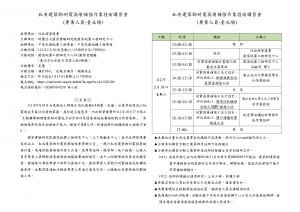
私有建築物耐震弱層補強專題演講

親愛的會員好:

代轉發國家地震工程研究中心私有建築物弱層補強專案辦公室謹訂於111年12月23日(星期五)上午9時30分假國家地震工程研究中心一樓103會議室舉辦「私有建築物耐震弱層補強專題演講」,邀請旅紐工程師許琳青技師來進行專題演講,演講主題為紐西蘭既有建築物耐震評估與補強實務經驗分享。
邀請函及議程詳附件謝謝!

私有建築物耐震弱層補強專題演講DM

敬祝 平安順心

中華民國結構工程學會 敬啟

第18屆第二次會員大會會員通知

親愛的會員您好,

本學會謹訂於中華民國111年12月17日上午8:30(星期六)假國家地震工程研究中心一樓會議室(臺北市大安區辛亥路3段200號)辦理第18屆第二次會員大會,特此通知,紙本開會通知已發送。敬邀各位會員蒞臨與會,大會通知書詳如附件,敬請查收,謝謝。

【停車資訊】本學會已向台大租借國家地震中心旁台大停車場(上午8:30~下午17:00)供會員停車,會員如開車與會,可停在該停車場,惟出入皆須配合現場人員刷卡進出且只限由辛亥路國震中心旁入口進出,無法由基隆路入口進出,尚請見諒。此外,最晚於當天(12/17)下午17:00前須駛離,否則停車場感應卡即失效,無法再進出,請大家務必配合,謝謝。)

中華民國結構工程學會 敬啟-12/05/2022

停車場地圖 :

附件:

第18屆第二次會員大會會員通知


停車場地圖


國震中心與結構學會 2022工程技術講座 (3)

親愛的會員好,

   提供以下講座資訊,歡迎踴躍參加,謝謝。

中華民國結構工程學會 敬啟-11/29/2022

2022工程技術講座(3)

主辦單位:財團法人國家實驗研究院國家地震工程研究中心、

                      中華民國結構工程學會。

協辦單位:華熊營造股份有限公司、施忠賢結構技師事務所。

時間:民國111年12月14日 (星期三)。

地點:國家地震工程研究中心一樓R101會議室。

費用:300元整,民國111年12月7日(星期三)前截止報名。

報名方式:即日起開始報名,請上網址:https://conf.ncree.org.tw/indexCht.aspx?n=A11112140

備註:本研討會已向行政院公共工程委員會申請技師積點及公務人員終身學習護照相關證書。

聯絡人:莊勝智/sjjhuang@ncree.narl.org.tw

                紀凱甯/ knchi@narlabs.org.tw

莊勝智 Sheng-Jhih, Jhuang
財團法人國家實驗研究院國家地震工程研究中心
National Center fot Research on Earthquake Engineering
地址台北市大安區辛亥路三段200
TEL
02-66300829
FAX
02-66300858
E-MAIL: sjjhuang@narlabs.org.tw

「強震建築健康分析與結構安全維護管理」 研討會

各位敬愛的貴賓 您好 :
在IOT、大數據及AI科技持續發展下,對於建物面對地震的監測、減災、防災小有成效。故本次活動為統籌近年有關建築健康分析與結構安全維護之研究發表

為感謝各界各位
對本會籌辦研討會的熱心支持、促成、參與

特此誠摯邀請出席 12/20 (二) 09:00
於張榮發基金會(台北市中正區中山南路11號11樓1101室)
舉行之「強震建築健康分析與結構安全維護管理」 研討會

期待您的蒞臨

中華民國結構工程學會 敬邀

請協助於12/10前填寫資料回覆,相關問題皆歡迎與台灣建築中心聯絡人劉小姐(#209)、羅小姐(#196)聯繫洽詢 : (02) 8667-6111,感謝您。

鋼骨鋼筋混凝土構造規範修正研擬及耐震技術講習會

親愛的會員大家好,

代轉發以下資訊:

鋼骨鋼筋混凝土構造規範修正研擬及耐震技術講習會

主辦單位:內政部建築研究所、中華民國地震工程學會

協辦單位:財團法人國家實驗研究院國家地震工程研究中心

時    間:111年11月21日(星期一) 下午01:30至下午5:00

地    點:大坪林聯合開發大樓15樓國際會議廳

          (新北市新店區北新路三段200號)

費    用:免費

名    額:額滿為止。

報名方式:即日起至111年11月16日完成報名。

報名網址:https://conf.ncree.org.tw/index.aspx?n=A11111210

聯絡電話:02-66300924 林瑞綿 小姐

備    註:

(一)   本講習會已向行政院公共工程委員會申請技師換證積點,及公務人員終身學習積點。

(二)   因應新冠肺炎疫情蔓延,與會人員請落實自我健康狀況監測,有發燒(耳溫高於38度C或額溫高於37.5度C)、呼吸道症狀或腹瀉等,應避免參加本次活動,建議參與活動期間,自備口罩及飲用杯具,以維護自身與他人安全。

校舍混凝土結構耐久性與耐震能力評估手冊講習會DM


中華民國結構工程學會 敬啟-11/08/2022

「建築物耐震設計規範及解說」部分規定修正說明會

親愛的會員大家好,

代轉發以下資訊:

「建築物耐震設計規範及解說」部分規定修正說明會


   位:內政部營建署

   位:財團法人國家實驗研究院國家地震工程研究中心

內政部營建署業於111年6月14日以台內營字第1110810765號令修正「建築物耐震設計規範及解說」部分規定,自中華民國111年10月1日生效,因本次規範內容有相當幅度修改,為向業界及各相關團體推廣與說明本次修正重點,並正確運用規範要求,爰在台灣北、中、南部地區舉辦宣導說明會。

北、中、南三場說明會的報名網頁如下:

台北場(2022年11月8日,地點:國立台灣大學應用力學研究所國際會議廳)

https://conf.ncree.org.tw/index.aspx?n=A11111010

台中場(2022年11月18日,地點:國立中興大學雲平廳)

https://conf.ncree.org.tw/index.aspx?n=A11111180

台南場(2022年12月1,地點:台南文化創意園區1A香蕉商場)

https://conf.ncree.org.tw/index.aspx?n=A11112010


中華民國結構工程學會 敬啟-11/01/2022